
Case study · Women's fashion e-commerce, Egypt · Meta
Scaling Meta Ads for a Fashion Brand: +160% Revenue in Seven Months
Seven months. One paid channel. Every month up year over year, held at 2.4x the brand's 5x breakeven throughout. The return compressed from about 16x to about 12x by design, and never fell below 1.6x in the leanest month.
Outcomes, year over year
The receipts
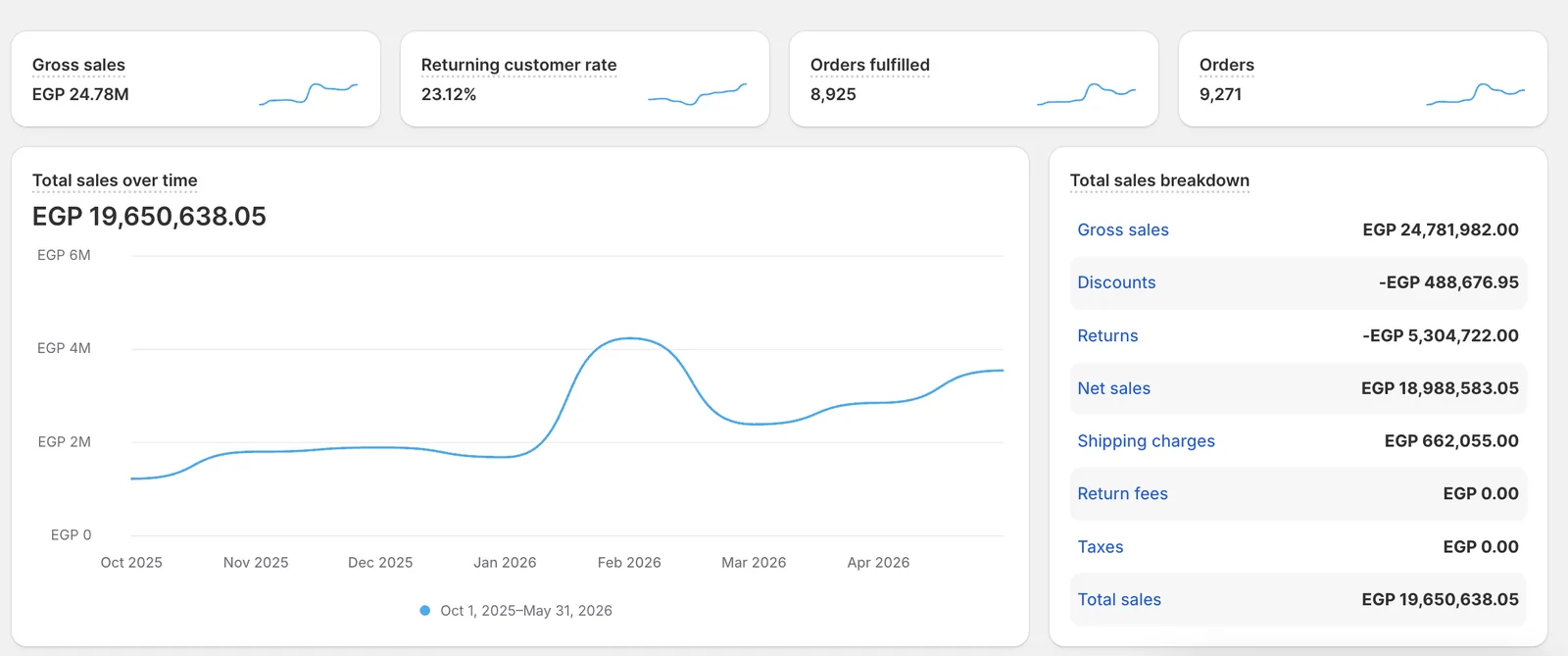
Straight from the brand's Shopify dashboard.
No edited screenshots, no platform-only metrics. This is the store's own sales reporting for the engagement window.
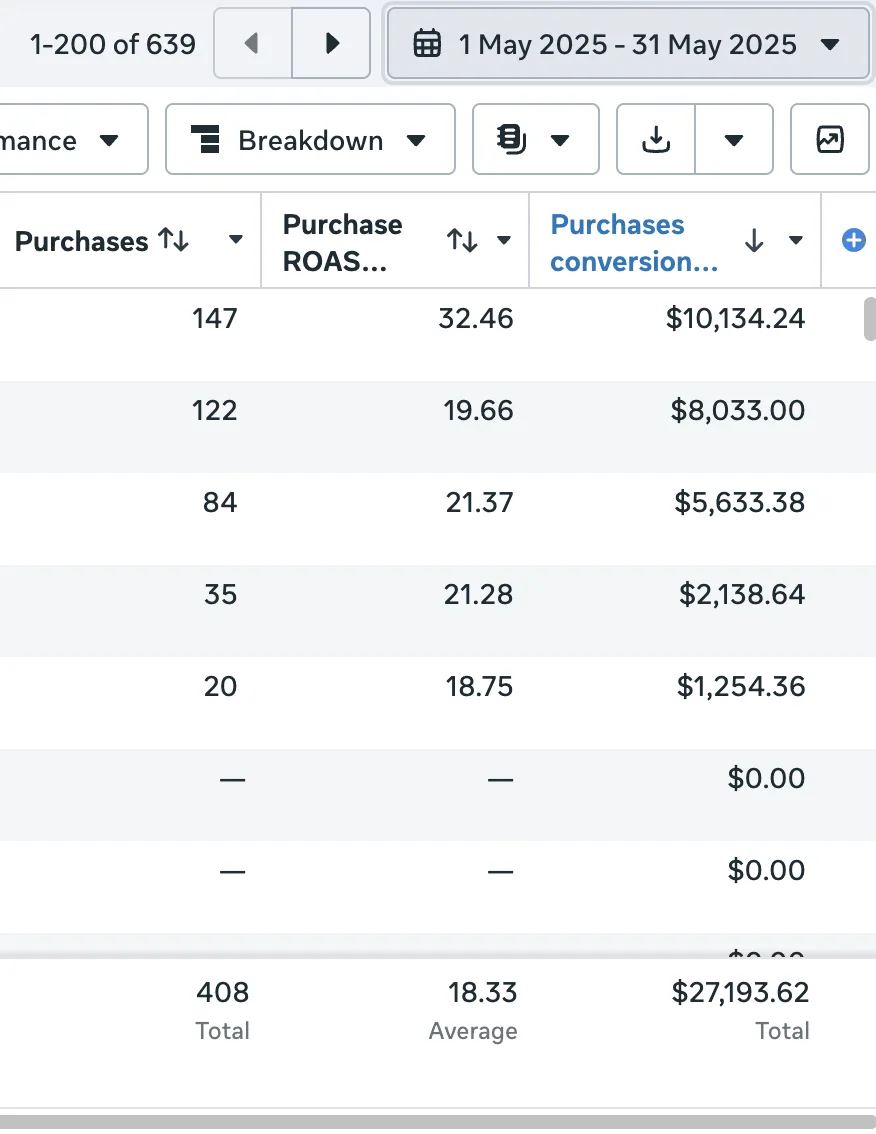
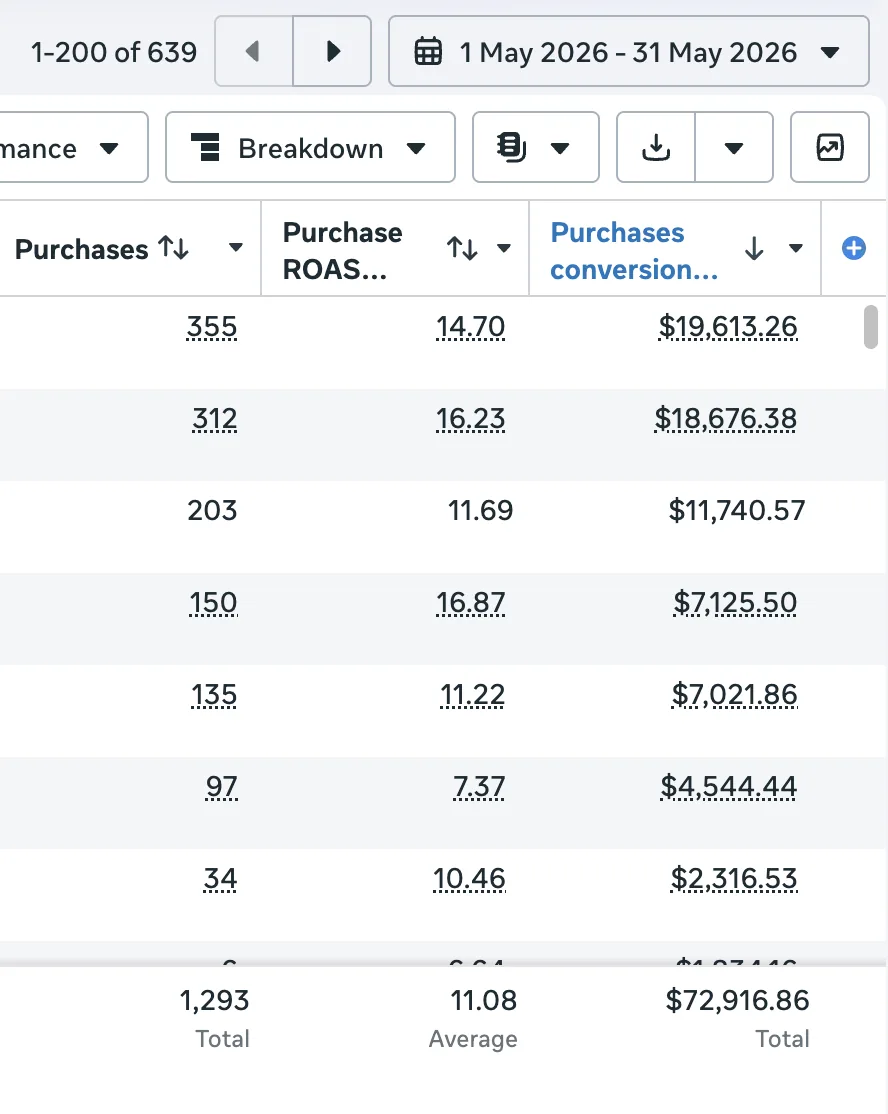
The same month, one year apart, inside Meta Ads Manager.
May 2025 versus May 2026 from the ad account itself. Purchases more than tripled and revenue rose roughly 168%, with ROAS compressing from 18.33 to 11.08 as spend scaled into demand, exactly as planned against the brand's breakeven.
The starting state
A demand problem disguised as a success metric
This was a fashion brand returning 16x on Meta on a deliberately small budget. A 16x return reads like discipline. On a brand this size it was the signal that profitable demand was going uncaptured, month after month, because the spend behind it was too small to reach it.
The tracking was already clean and the measurement sound, which is the precondition most accounts are missing and this one was not. Capture, the data and measurement layer, is the first phase of the Capture, Convert, Compound method and usually the missing piece. Here it was already sound. We still audited the tracking end to end to confirm it before scaling a dirham. The problem was not the data, and it was not the demand. It was the budget. So once Capture was verified, the heavy lifting began at Convert.
How we engineered it
Scaling Meta ads profitably is a supply problem, not a spend problem.
Capture
Every engagement starts with the data and measurement layer, because nothing built on top of it can be trusted if it is wrong. We audited the tracking end to end before touching spend, and confirmed what most accounts get wrong was already right here: clean signal, sound measurement. Nothing to rebuild, so scaling decisions could rest on real numbers.
- Tracking and conversion signal audited end to end
- Attribution and measurement verified sound before any scaling
- Clean data confirmed, so every later decision rested on real numbers
Convert
The creative library was never the constraint. What the account had not done was test at the rate that scaling Meta ads at this pace demands. We changed the testing cadence, running more creative tests than the account had ever run. The point was supply, not novelty.
- Testing cadence raised to the highest in the account's history
- Fresh tests fed the auction faster than winners decayed
- Link click-through rose 4.15% to 4.52% while spend climbed to 3.6x
- Frequency dropped 6.2 to 4.6 as reach nearly doubled
Compound
Over seven months we pushed monthly spend to roughly 3.6x its pre-engagement level, and revenue scaled with it rather than behind it. Revenue grew 160% YoY and orders 152%, on the same brand and the same single channel. Every month in the window beat the same month the year before.
- Content views grew about 160%, checkouts initiated about 185% YoY
- AOV held within 3%, so growth came from volume, not basket inflation
- Return compressed 16x to 12x by design, never near the 5x breakeven
- The brand's biggest sales month on record, going back to 2022
Questions founders ask about scaling Meta ads
How do you scale Meta ads for a fashion brand without killing ROAS?
Scale into demand you already have, and keep creative supply ahead of fatigue. This brand tripled spend while link click-through rose and frequency fell, which held the return above 2.4 times breakeven the whole way.
What happens to ROAS when you increase ad spend?
It usually compresses, because you reach beyond your most efficient audiences. Here it fell from about 16x to about 12x as spend grew 3.6x, expected and planned for against a 5x breakeven.
Is a high ROAS on low spend a good sign?
Not always. A 16x return on a small budget often means profitable demand is going uncaptured. The gap between that return and breakeven is budget left on the table.
How much can you scale Meta spend profitably?
As far as the gap to breakeven allows. With a 5x breakeven and a 16x starting return, this account had room to more than triple spend and still clear breakeven by 2.4x.
Does more creative testing help when scaling Meta ads?
Yes. Heavier testing kept fresh ads entering the auction faster than winners fatigued, which is why click-through rose and frequency fell even as spend tripled.
Book a call
Same channel. More than double the revenue. The room was there the whole time.
If your return looks high on a small budget, that gap to breakeven is budget left on the table. We'll show you where it is.