

What is a blue ocean marketing strategy?
A blue ocean marketing strategy is an approach that creates new, uncontested market space instead of competing for share in an existing one. Rather than fighting rivals over the same customers, you make those rivals irrelevant by opening demand that did not exist before.
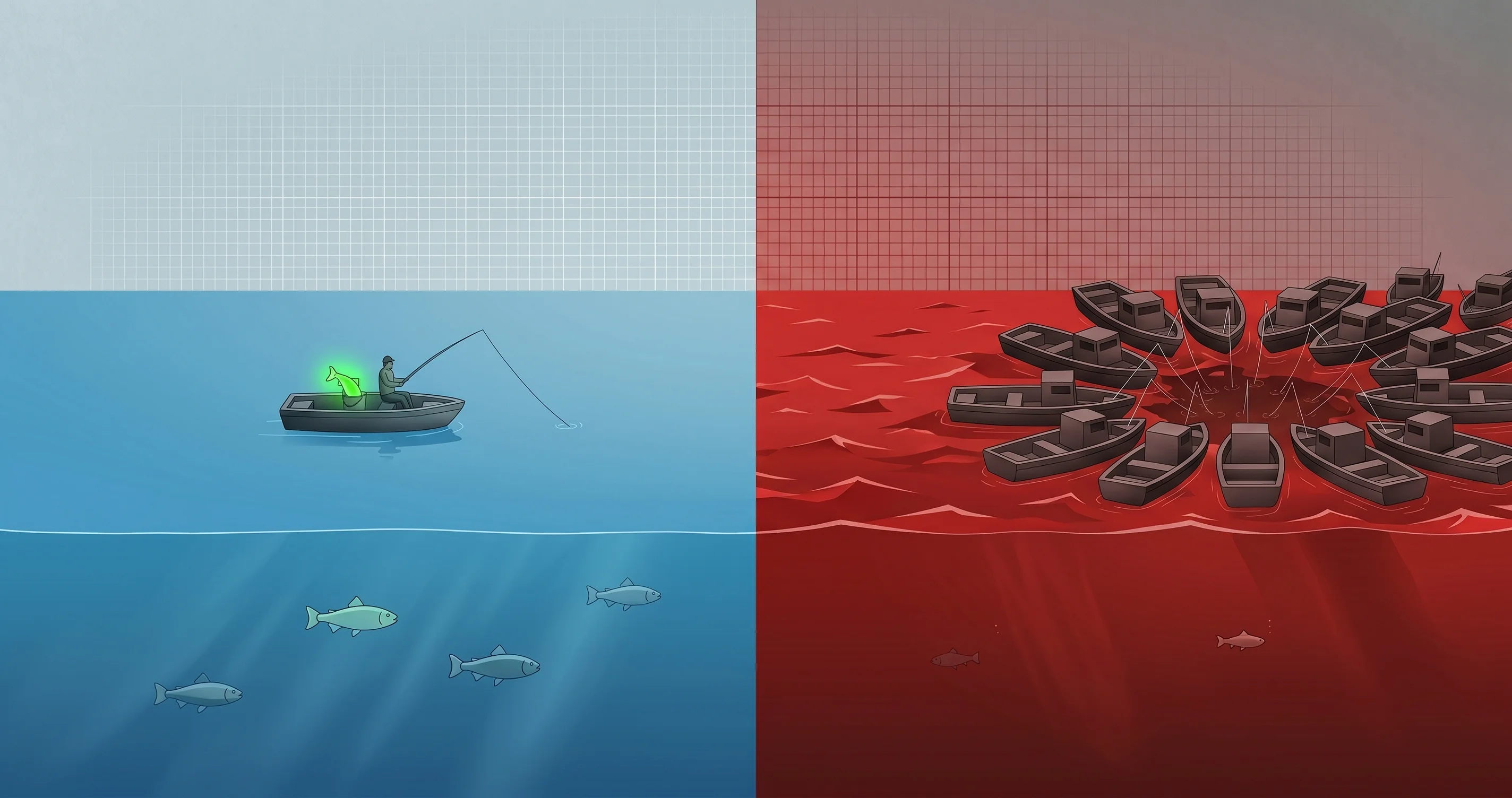
The term comes from W. Chan Kim and Renee Mauborgne, INSEAD professors who published Blue Ocean Strategy in 2005. Red oceans are known industries with defined boundaries, where companies fight over a shrinking profit pool until the water turns bloody. Blue oceans are market space that has not been created yet, where demand is made rather than fought over.
The mechanism that separates the two is value innovation. Most strategy forces a choice: differentiate and charge more, or strip features and charge less. Blue ocean rejects the trade-off. You pursue differentiation and low cost at the same time, which gives buyers something new at a price the incumbents cannot match without rebuilding their entire cost structure.
For a marketer, the translation of a blue ocean marketing strategy is simple. In a red ocean you spend to win attention away from competitors. In a blue ocean you spend to create attention for something the market has not seen. The second is cheaper, until it is not.
Blue ocean vs red ocean: the difference at every decision point
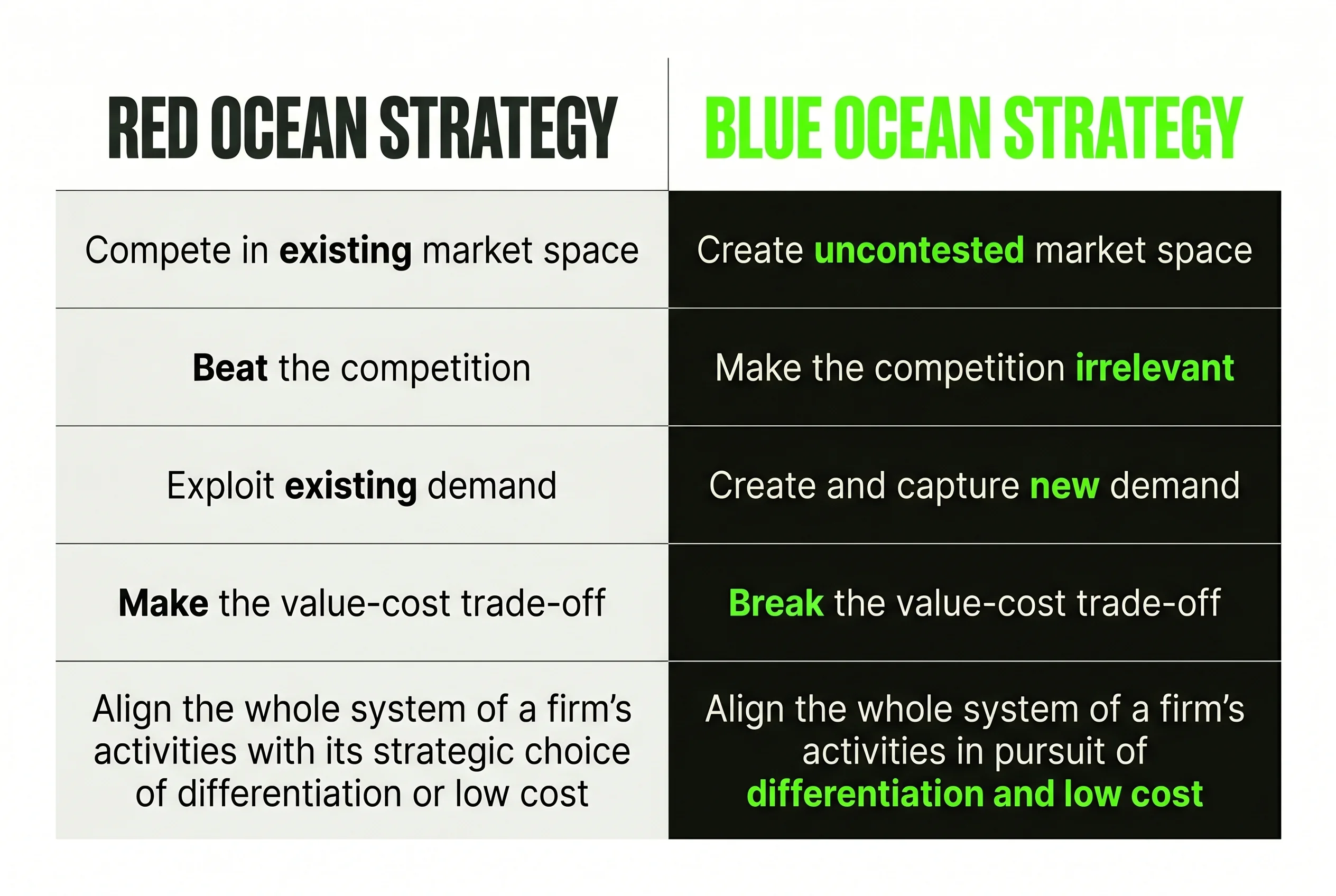
Most brands never choose the red ocean. They inherit it. You launch into the category that already exists, benchmark the competitors already there, and optimise to beat them on the metrics everyone already tracks. The blue ocean question is different. It asks which buyers the entire industry ignores, and what they would pay for if someone built it.
The blue ocean strategy framework: the tools that do the work
Two tools carry most of the weight: the Four Actions Framework and the Strategy Canvas.
The 4 pillars: the Four Actions Framework
What does the industry take for granted?
Remove the factors everyone assumes are required but no buyer truly values.
What is over-served?
Cut the factors the industry competes on well below the standard.
What is under-served?
Push the factors buyers actually care about well above the standard.
What has never been offered?
Introduce sources of value the industry has never thought to provide.
Eliminate and Reduce strip out cost. Raise and Create build the differentiation. Run all four at once and you get value innovation: a lower cost structure and a more compelling offer in the same move. Cirque du Soleil eliminated animals and star performers, which were expensive, and created theatrical storytelling, which was new.
The Strategy Canvas
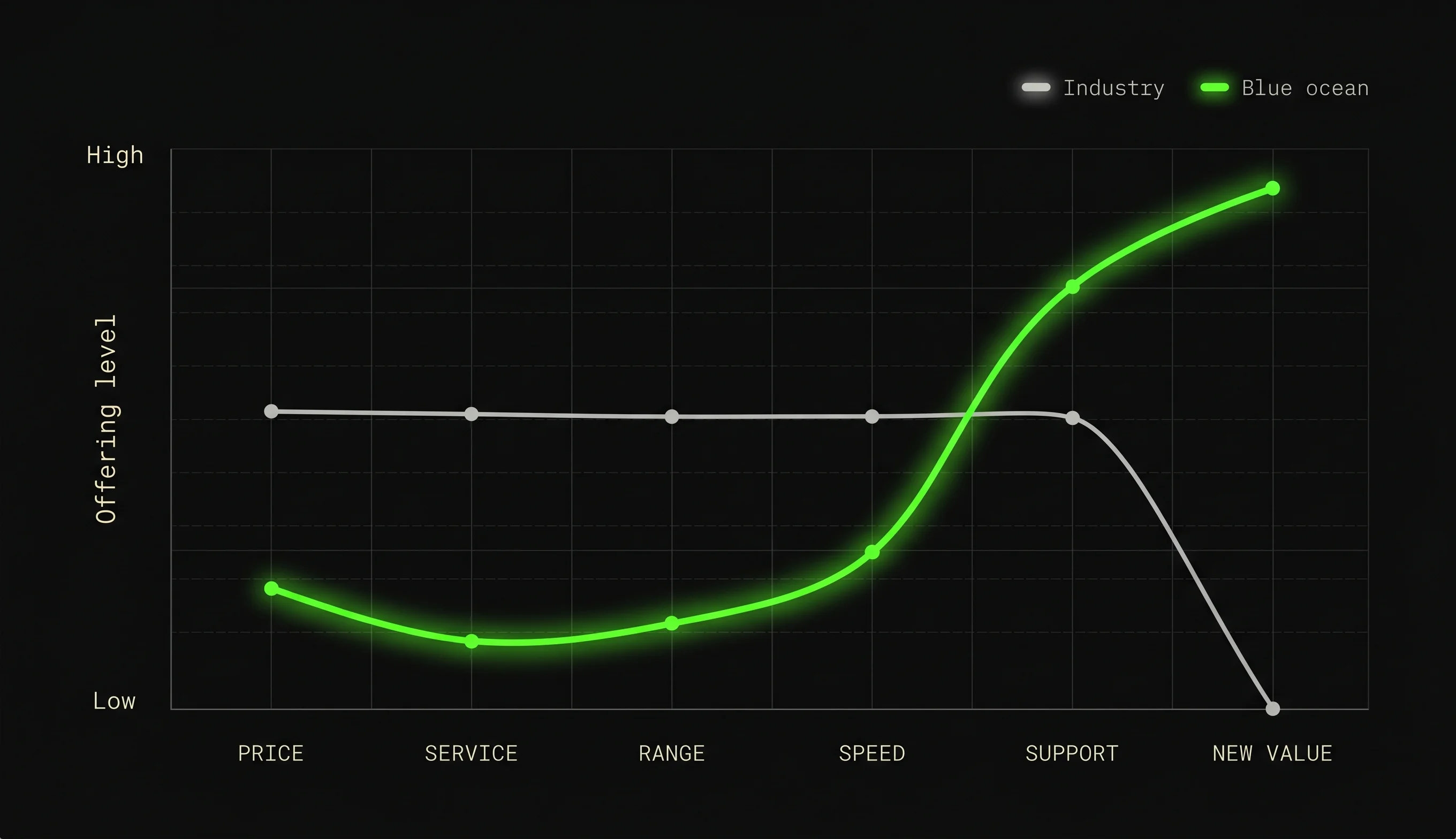
The Strategy Canvas plots your offer against competitors across the factors the industry competes on. When your curve traces the same shape as everyone else's, you are in a red ocean by definition. A blue ocean strategy produces a curve that diverges: low where the industry over-invests, high or entirely new where the industry has never looked.
The six principles
Kim and Mauborgne organised execution into six principles. Four govern formulation: reconstruct market boundaries, focus on the big picture not the numbers, reach beyond existing demand, and get the strategic sequence right. Two govern execution: overcome the key organisational hurdles, and build execution into the strategy from the start. The fourth principle is the one marketers underweight. Skip a step in the sequence and the result breaks, a point that returns later on this page.
Blue ocean strategy examples, and what they teach a marketer
A blue ocean marketing strategy is easiest to understand through the brands that ran one. Read them for the marketing move, not the trivia.
- Cirque du Soleil sold to adults and corporations who would never buy a circus ticket. It reached the non-customer.
- Southwest Airlines competed against the car, not other airlines, so its real rival was a tank of gas.
- Nintendo Wii sold motion control to families and non-gamers, expanding the market instead of slicing the existing one thinner.
- yellow tail made wine simple for people who found it snobbish, competing for beer and cocktail drinkers.
Every one of these won by aiming marketing at people the industry was not even speaking to. That is a blue ocean marketing strategy in practice: a different market, not better targeting inside the same one. And each took years and serious capital to build. That barrier kept the oceans blue long enough to matter. In 2026, that barrier is gone.
Is blue ocean strategy still relevant in the age of AI?
Yes, blue ocean strategy is still relevant, but its timeline has changed. AI has collapsed the cost of entering a market, so uncontested space now stays uncontested for months rather than years. Finding a blue ocean is still valuable. Treating it as a permanent moat is now a mistake.
A competitor can stand up a storefront in an afternoon, generate a hundred creative variants before lunch, and copy your exact positioning from your own landing page in a single prompt. The research, production, and iteration that used to take a funded team a full quarter now takes one person a weekend.
Stanford's 2025 AI Index Report found that the cost of running a GPT-3.5-level model fell more than 280-fold between November 2022 and October 2024, from $20 per million tokens to $0.07. Over the same stretch, business adoption of AI climbed from 55% to 78%.
So the open water fills faster. The strategy did not fail. The half-life of the advantage shrank. In 2005, building the thing was hard enough that the idea was protected by the difficulty of copying it. When copying becomes nearly free, the idea protects nothing. Which leaves the only question that matters: if the market gap is no longer defensible, what is?
The moat is no longer the market gap. It is the compounding system.
A blue ocean marketing strategy used to end at finding the gap. In the AI era it has to start there. Anyone can copy your positioning. Nobody can copy your first-party data, your tested creative library, or a measurement layer wired to your specific customers and your real margins. Those are assets that take converted volume and time to build, and they get stronger every month while your imitators are still on month one.
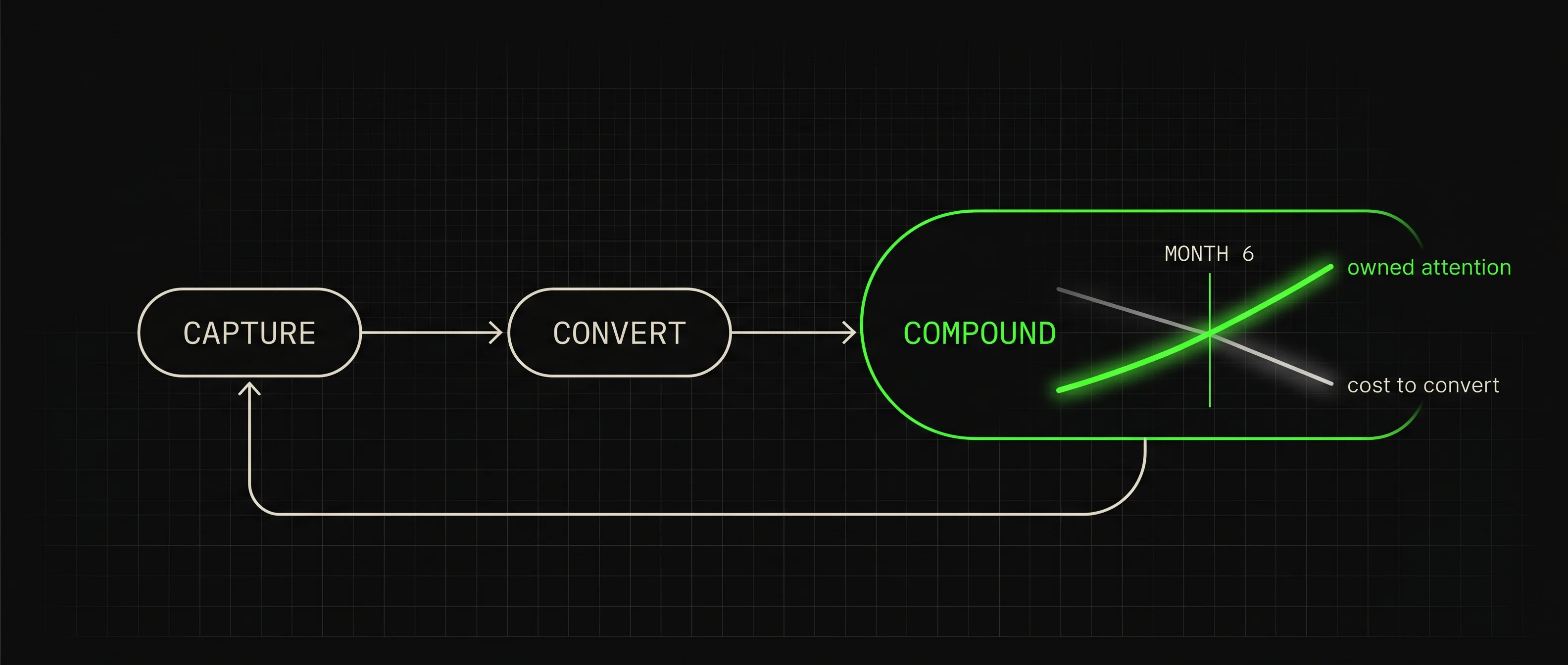
This is the difference between renting attention and owning it. We build that system in a fixed order: Capture, then Convert, then Compound. The order is the argument.
Clean the data layer
Server-side tracking and the Conversion API on Meta and Google, with segmentation across SKUs built with scripts. Creative tested on dirty data scales noise.
Win the click
Once the data tells the truth, the creative engine wins the click before it happens, tested against real conversion signal, not platform-reported vanity metrics.
Build the asset
First-party audiences deepen with every purchase. Creative wins compile into a library. By month six, the last campaign is making the next one cheaper.
A red-ocean brand that out-executed its market
TyresOnline is a 5,000-plus SKU e-commerce brand in the UAE, selling tyres, one of the most commoditised, price-shopped, red-ocean categories there is. There was no uncontested market space to find, so the work went into building the compounding system instead. Browser-side tracking was losing conversions to cookie loss and ad blockers, so the platforms were optimising against signal that undercounted what was actually selling. Server-side tracking and the Conversion API closed that gap, deduplicated events, and fed back purchases the pixel alone had missed.
TyresOnline UAE: +67% YoY revenue on the same spend profile. Google ROAS 13.95 to 19.48. Meta ROAS 9.77 to 14.32.
These are year-over-year figures, which rules out a seasonal spike. The same spend produced more revenue because the system got smarter, not because the market got easier. The moat was never the product. It was the machine.
How to build a blue ocean marketing strategy that holds
- Find the gap. Run the Four Actions Framework against your category. Map it on a strategy canvas until your curve diverges.
- Aim at the non-customer. Speak to people the industry ignores, not the customers it already fights over. That is where the cheap attention is.
- Build the moat before the imitators arrive. The day you find open water, start compounding. Clean the data layer, capture first-party audiences, build the tested creative library.
- Get the sequence right. Capture before Convert, Convert before Compound. Skip a step and the result breaks.
The brands that own the next decade will not be the ones who find the most blue oceans. They will be the ones who keep an ocean blue the longest, because they built something underneath it that a prompt cannot copy.
Frequently asked questions
What is the blue ocean strategy in marketing?
A marketing approach that creates new, uncontested demand instead of competing for existing customers. You aim marketing at people the industry does not serve, which makes the competition irrelevant. The two anchors are differentiation and low cost pursued at the same time.
What are the six principles of blue ocean strategy?
Four govern formulation: reconstruct market boundaries, focus on the big picture not the numbers, reach beyond existing demand, and get the strategic sequence right. Two govern execution: overcome the key organisational hurdles, and build execution into the strategy itself.
What are the 4 pillars of blue ocean strategy?
The Four Actions Framework: Eliminate, Reduce, Raise, Create. Eliminate and Reduce remove cost. Raise and Create build differentiation. Applying all four at once produces value innovation.
Is blue ocean strategy still relevant?
Yes, but its timeline has compressed. AI has lowered the cost of entering a market, so uncontested space stays uncontested for months rather than years. The durable advantage now comes from a compounding system of owned audiences, clean data, and a tested creative library that competitors cannot copy quickly.
What are the 3 C's of strategy?
Company, Customers, and Competitors. Blue ocean strategy deliberately drops one of them. By centering the competitor, the 3 C's keep you in a red ocean. Blue ocean strategy removes the competitor from the equation and focuses on creating demand among non-customers.